Agra In the north Indian state of Uttar Pradesh, is undoubtedly one of the most famous cities in India, steeped in both culture and architectural history. Agra is known for its world-famous monument, the Taj Mahal and appeals to millions of Tourists every year. However, apart from the Taj Mahal, there are a lot of places to visit in Agra that make this place worth visiting for the travelers. This Complete Guide will help you enjoy the historical, cultural and culinary pleasures Agra has in store for you.
1. Taj Mahal – The Jewel of India
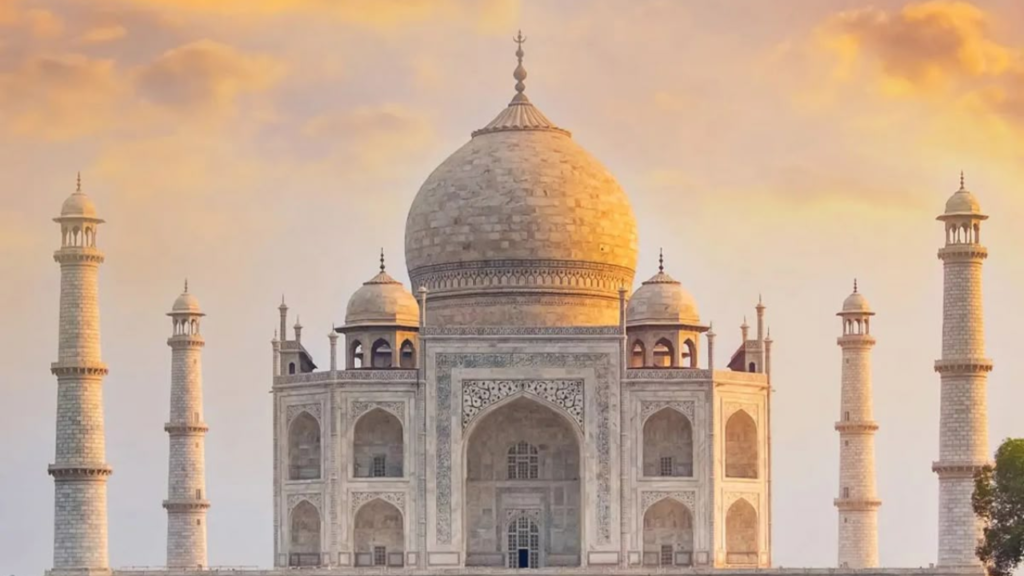
A UNESCO World Heritage Site and one of the wonders of the world, the Taj Mahal in Agra, built on the banks of the Yamuna River, is one of the most recognisable monuments of the world and an experimental sign of love. Constructed in 1632 under the orders of Mughal Emperor Shah Jahan in memory of his wife, Mumtaz Mahal, who died giving birth to their thirteenth child. This white marble mausoleum took over 22 years to build, involving thousands of craftsmen and labourers from all over India, Central Asia and Persia.
The Taj Mahal is a mausoleum of Mughal architecture; it combines elements from the Islamic, Persian, Ottoman Turkish, Mughal and Indian architectural styles. With its perfect symmetry, stunning full-dimensional inlay work with precious and semi-precious stones, and exquisite calligraphy, it is famous around the globe as a hallmark of its kind. The central dome, bordered on four sides with four minarets rising from the land, stands above the gardens, sharing this geometric harmony so central to Mughal ideals.
The Taj Mahal was intended to be more than a tomb; it was to be an expression of Shah Jahan’s love and devotion. In 1983, it was designated a UNESCO World Heritage Site for its beauty, historical, and cultural significance. And today, it is one of the must-visit places in Agra, with millions of tourists from around the world visiting it every year to experience its beauty and romance.
Agra Fort – A Steel Door Beauty
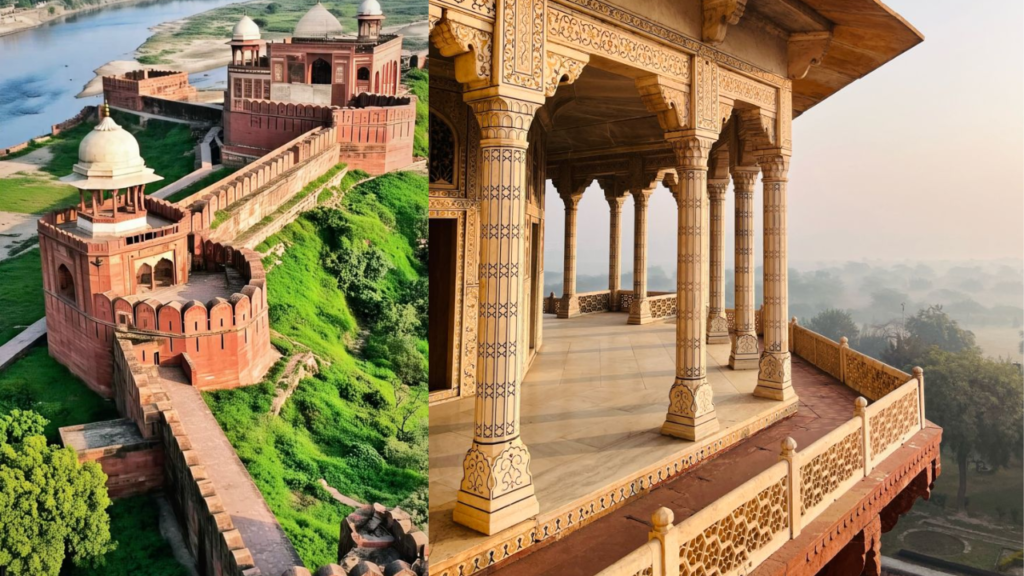
One of the most prominent sites of pure Mughal glory, Agra Fort, which stands at just 2.5 kilometres away from the Taj Mahal, is also a UNESCO World Heritage Site. A brick fort under Rajput rule, it was converted into a stunning red sandstone fort by Emperor Akbar in 1565. From the fort, the Mughal emperors ruled until the capital was moved to Delhi in 1638.
Agra Fort is not only a military stronghold but also a palace complex that covers over 94 acres and is made of intricate structures that embody Mughal architectural extremes. Palaces, audience halls, mosques, and gardens are located behind its walls, including Jahangir Palace, Khas Mahal, Diwan-i-Am (Hall of Public Audience), and Diwan-i-Khas (Hall of Private Audience). The fort was a fortress; big walls that stood more than 20 meters gave it a defence capability, while inner beauty depicted the riches and comfort of the Mughal Empire.
Akbar used it as a seat of power in his early years, and Shah Jahan spent the final years of his life imprisoned within the fortress. Combining the rigidity of the military with the grace of form, it is perhaps among the most exquisite places to visit in Agra to slow time and relish the pomp of the Mughal age.
Fatehpur Sikri – the city of faded fortunes
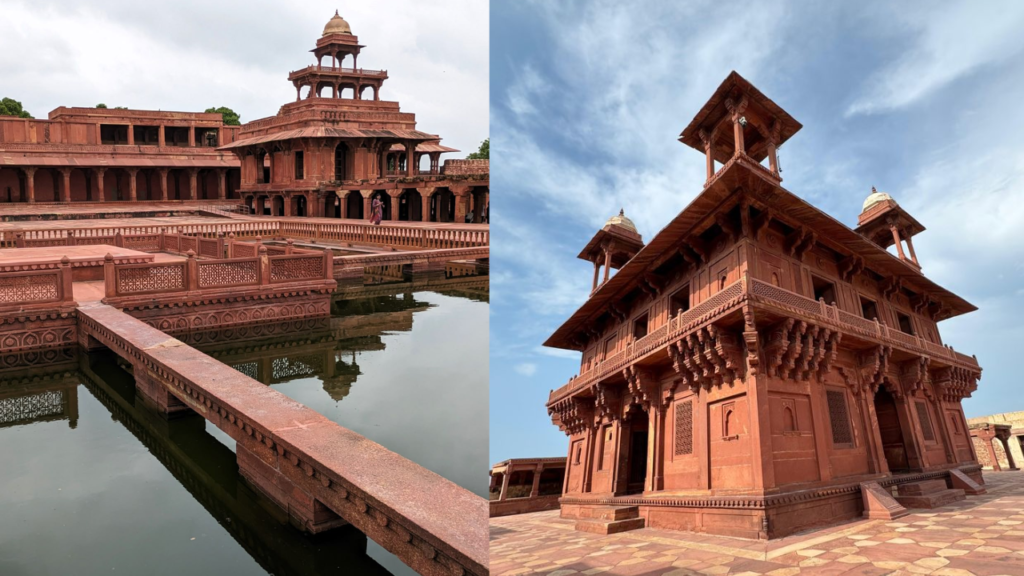
Fatehpur Sikri About 40 km from Agra, Fatehpur Sikri is one of the best examples of the magnificent structures built by Emperor Akbar and is a UNESCO World Heritage Site. Constructed in 1569, this red sandstone city was the Mughal capital for only a short time before it was deserted after the water supply ran dry. Fatehpur Sikri showcases Akbar’s architectural genius as a city made of palaces, courtyards and mosques built in the Persian, Indian and Islamic style.
Buland Darwaza: Considered as one of the largest gateways in the world, Buland Darwaza is a masterpiece built to commemorate the Mughal Emperor Akbar’s success in 1573 and herald the glory of Islam and the city of Fatehpur Sikri. Jama Masjid: Surrounded by beautiful gardens, this mosque is located near the top of Fatehpur Sikri and serves as the main mosque for the city.
Panch Mahal: This is a five-story palace ideal for royal leisure time with musicians and dancers. The tomb of the Sufi saint, Salim Chishti, is also set within Fatehpur Sikri and is often visited for blessings.
The city serves to demonstrate imperial might and universal spirituality. Even though it was only occupied for a short span of time, Fatehpur Sikri ranks as one of the must-see sites around Agra. The Mughal Caravanserai features preserved buildings and open courtyards that symbolise the Mughal lifestyle and governance, and the architectural innovation pf the Mughal period are a must-stop for history buffs and travellers.’
Sunset Views of Taj from Mehtab Bagh
Mehtab Bagh is a gorgeous garden located across the Yamuna River from the Taj Mahal, which translates to the ‘Moonlight Garden. Using the charbagh style (a type of quadrilateral garden), the garden was first built by Emperor Babur early in the 16th century and expanded by later Mughal emperors to provide a literal symmetry of symmetry with the Taj Mahal on the opposite bank.
Mehtab Bagh was not only a garden for recreation and royal meeting, but also a place for strategic observation of the Taj Mahal and the Yamuna River. Staying true to the Golden Mean of Mughals, it provides its luxurious, lush greenery, water channels, and fountains. The garden was laid to waste over the centuries; however, the Archaeological Survey of India later restored it to its original form.
In the present day, Mehtab Bagh ranks among the more tranquil spots to visit in Agra, more so, the ideal place for photographers and wanderers to catch the view of the Taj Mahal setting against the brilliant glow of the setting sun. The garden is not only aesthetically pleasing, but the historical importance and the scenic beauty provide an ideal solace against the busy and crowded city, emphasising the art of garden designing and city planning by the Mughal dynasty.
5. Itimad-ud-Daulah’s Tomb – The Baby Taj
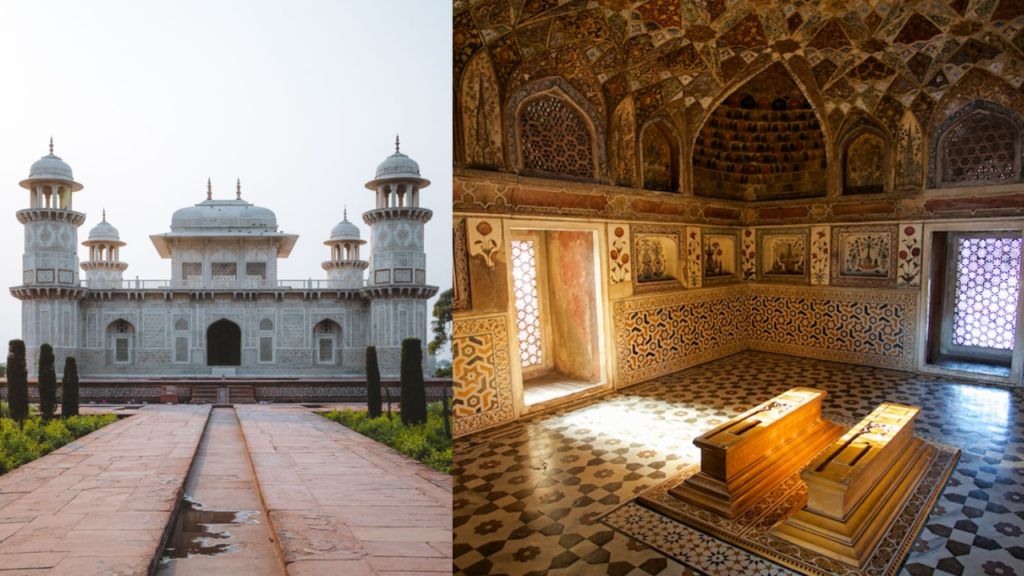
The Tomb of Itimad-Ud-Daulah, or “Baby Taj,” was constructed between 1622 and 1628 by the Mughal Empress Nur Jahan for her father, Mirza Ghiyas Beg, Prime Minister of the Mughal Empire. This Tomb of Itimad-Ud-Daulah has been seen as one of the precursors of the future Taj Mahal, with many of the architectural features that later were refined by Shah Jahan.
Built entirely of white marble with intricate inlaid work in pietra dura, decorated with semi-precious stones and with delicately carved lattice-work screens, four symmetrical minarets, symmetrical layout, and beautifully planned gardens show the Mughal emphasis on beauty and harmony. Itimad-Ud-Daulah is much less crowded than the Taj Mahal and is thus a peaceful and more intimate experience for visitors.
Historically, the Tomb of Itimad-Ud-Daulah represents a shift from using red sandstone to the use of white marble in Mughal architecture and influenced all Mughal architecture that would follow this period. The exquisite artistry and personal significance of this tomb make it one of the most beautiful places to visit in Agra. This “Baby Taj” stands as a testament to the strength of love and dedication and the high level of quality in Mughal craftsmanship and is thus a must-see for anyone looking for a deeper historical understanding of Agra beyond the famous Taj Mahal.
Also Read:- Mangal Pandey Park
6. Akbar’s Tomb, Sikandra
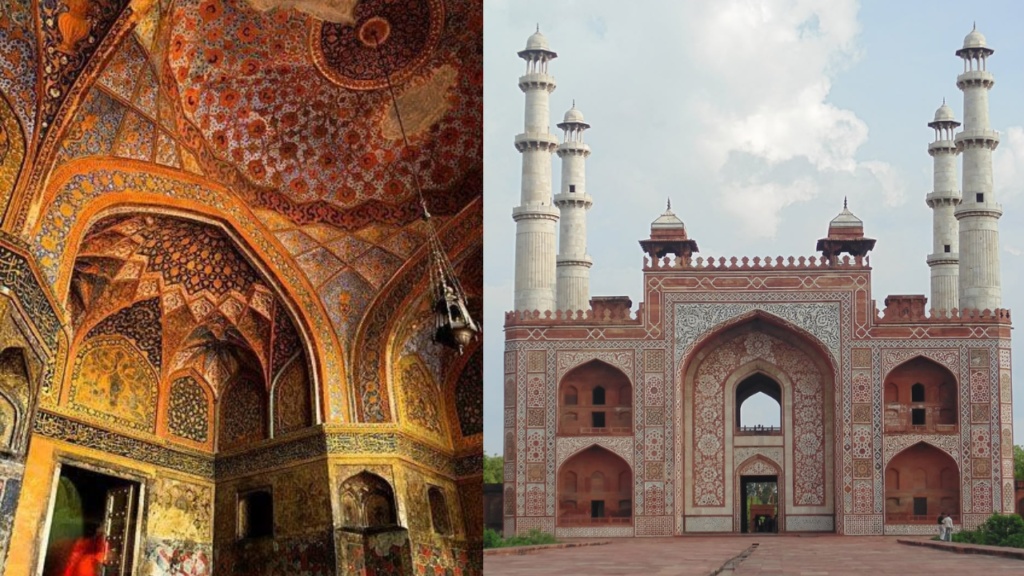
Located in Sikandra, a sleepy area near Agra, Akbar’s tomb is where Akbar the Great, one of India’s greatest emperors, is buried. Construction of this grand burial place commenced in 1605 and was completed between 1613 under Akbar’s son, Jahangir. Combining Persian, Islamic, Hindu and Mughal architectural styles, this tomb has been recognised as one of the finest examples of Mughal architecture.
Akbar’s tomb is situated in a large garden and is surrounded by a large entry gate, comprised of deep red sandstone and detailed inlaid work finished with marble and precious stones. The main tomb contains a cenotaph, marble and precious stones. In addition to the main tomb, Akbar’s tomb also contains areas with mosques, entryways and smaller mausoleums.
Historically, Akbar’s tomb has served to remember and honour a ruler who united the Mughal Empire and fostered arts, culture and governance. Today, it is a must-see attraction for any visitor to Agra and provides an insight into Mughal architecture, royal history and the legacy of Akbar’s rule. The tranquil location and majestic architecture make it a popular destination for many.
7. Jama Masjid – A Spiritual Stop
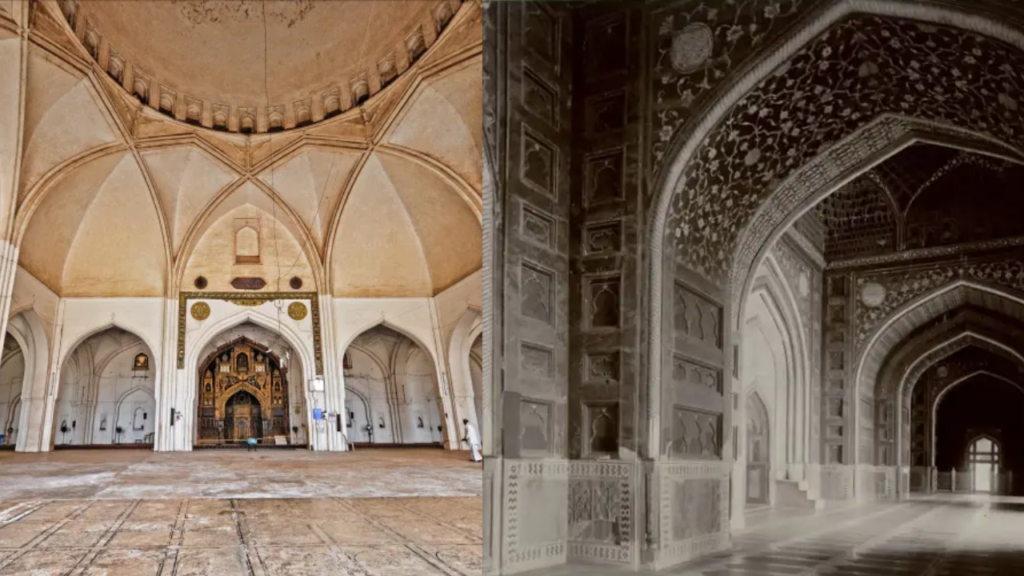
The Jama Masjid, built by Emperor Shah Jahan in Agra in 1648 for his daughter Jahanara Begum, is considered one of the largest and most important mosques built during the Mughal era. It is situated adjacent to the Agra Fort, which makes it a fantastic representation of Mughal architecture and the support provided by the Mughal Empire.
Constructed from red sandstone and white marble, the mosque has a large courtyard and several beautifully decorated prayer halls as well as three iconic domes. The eastern entranceway to the mosque was typically for royal use only and illustrates how significant it was to the Mughal court. The Jama Masjid was capable of holding thousands of worshippers simultaneously, demonstrating how vital it was in both religious life and social life during the Mughal period.
The Jama Masjid has great historical importance because it represents not only a house of worship, but also the expression of Shah Jahan’s deep devotion to Islamic architectural and urban planning styles. Today, it continues to serve as an active mosque and, therefore, is one of the best places to experience Islamic culture in Agra, allowing visitors to appreciate the distinctive architectural characteristics of Mughal architecture and to gain an understanding of the historical and cultural context of India during the 17th century.
8. Chini Ka Rauza – The Ceramic Wonder
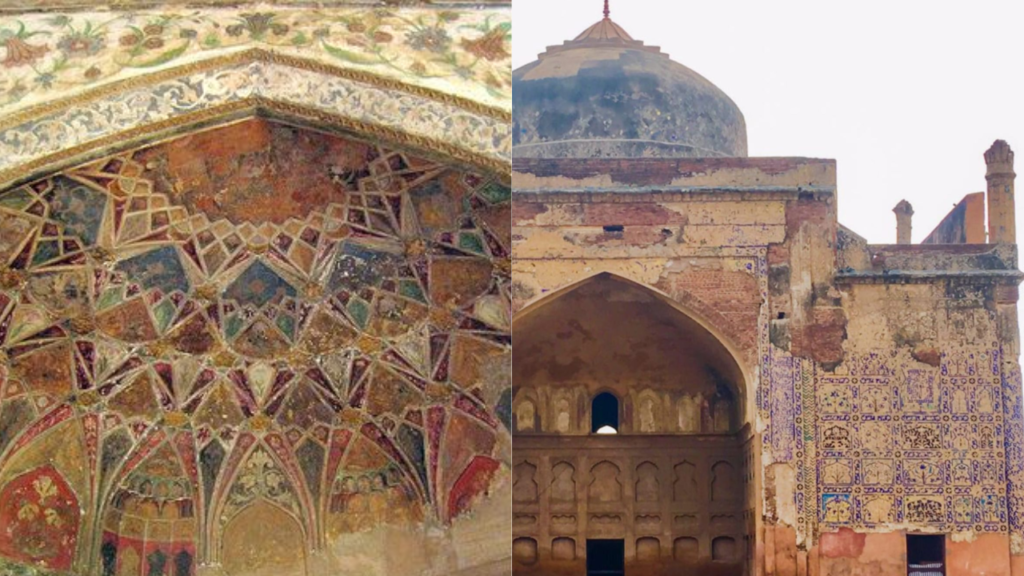
The Chini Ka Rauza is a tomb located in Agra that is not very well known but is extremely architecturally impressive. Chini Ka Rauza was built in the early 1700’s as a tomb for Afzal Khan Shirazi, a Persian poet and scholar, who was Prime Minister under Emperor Shah Jahan. This monument is notable for its elaborate and brightly colored glazed tiles (an example of Persian architectural design), significantly differentiating it from the other Mughal monuments found throughout Agra.
The name “Chini” refers to the brightly colored ceramic tiles that were brought from Persia and Central Asia and that originally covered the entire exterior of the tomb. The majority of these tiles have deteriorated over time due to weather wear, but the remainder of the tile patterns are still very indicative of the artistic skill and creativity of the time and represent the cultural cross-fertilisation taking place during this time period in the Mughal Empire. The Chini Ka Rauza illustrates both the Indo-Persian style of architecture and the creativity of the Mughal Empire.
Historically, the Chini Ka Rauza serves as an illustration of the connection shared by the Mughal Empire and Persian artists and writers; therefore, even today, it represents a uniquely distinct experience for people visiting Agra who want to experience something related to unique forms of historical art as well as lesser-known aspects of the history of the Mughal Empire.
Conclusion
Located in northern India, Agra is rich in both its culture and architecture. Known primarily for its beauty, represented by the Taj Mahal, Agra is home to several other wondrous attractions such as the Agra Fort and beautiful Mughal Gardens; each of these structures represents an aspect or theme associated with the human experience: love, power, and artistry; thus providing its own unique story.
When visiting these areas, you are engaging in an exploration of history, tradition, and life within this part of India. Whether you are a historian, photographer, or a first-time visitor to India, Agra provides an opportunity for rich memories and experiences that will last well beyond your departure from the area.
Also read:-Top 16 Places to Visit in Pune
FAQs
What are the best places to see in Agra?
At the top of the list are the Taj Mahal, Agra Fort, Fatehpur Sikri, Mehtab Bagh and Itimad-ud-Daulah.
How many days are enough for Agra?
Two to three days is sufficient to leisurely traverse the key sites of Agra.
When to visit Agra?
The ideal time to visit is from October till March as the weather is comfy for sightseeing during this span.
Can we visit Agra with the family?
Yes, Agra is family-oriented with historical monuments to visit, gardens, and cultural activities.
What are some day trips from Agra?
Yes, Mathura, Vrindavan and Fatehpur Sikri are favourite day trip destinations in the vicinity of Agra.